Choosing ceramic media shape is a geometry decision, not a shortcut based on a shape name. Cylinders, triangles, angle-cut pieces and other profiles contact edges, flats, recesses and openings differently. Start with the part drawing and the features that must be reached or protected, then screen candidate media against lodging, separation and finish risks in a controlled sample trial.
Before comparing shapes, mark the part features that control the decision: outside edges, broad faces, slots, holes, thread entrances, blind pockets and thin walls. Also record which surfaces may accept edge change and which must retain their original geometry. A media shape that reaches one feature can bridge across another, lodge in an opening or leave a witness pattern on a cosmetic face.
Use the part drawing to identify the smallest accessible opening and any two-point or three-point trapping condition. Nominal media dimensions alone are not enough because media wears and the effective contact geometry changes during use. For openings and internal features, use the separate media-size guide for holes, slots and cavities.
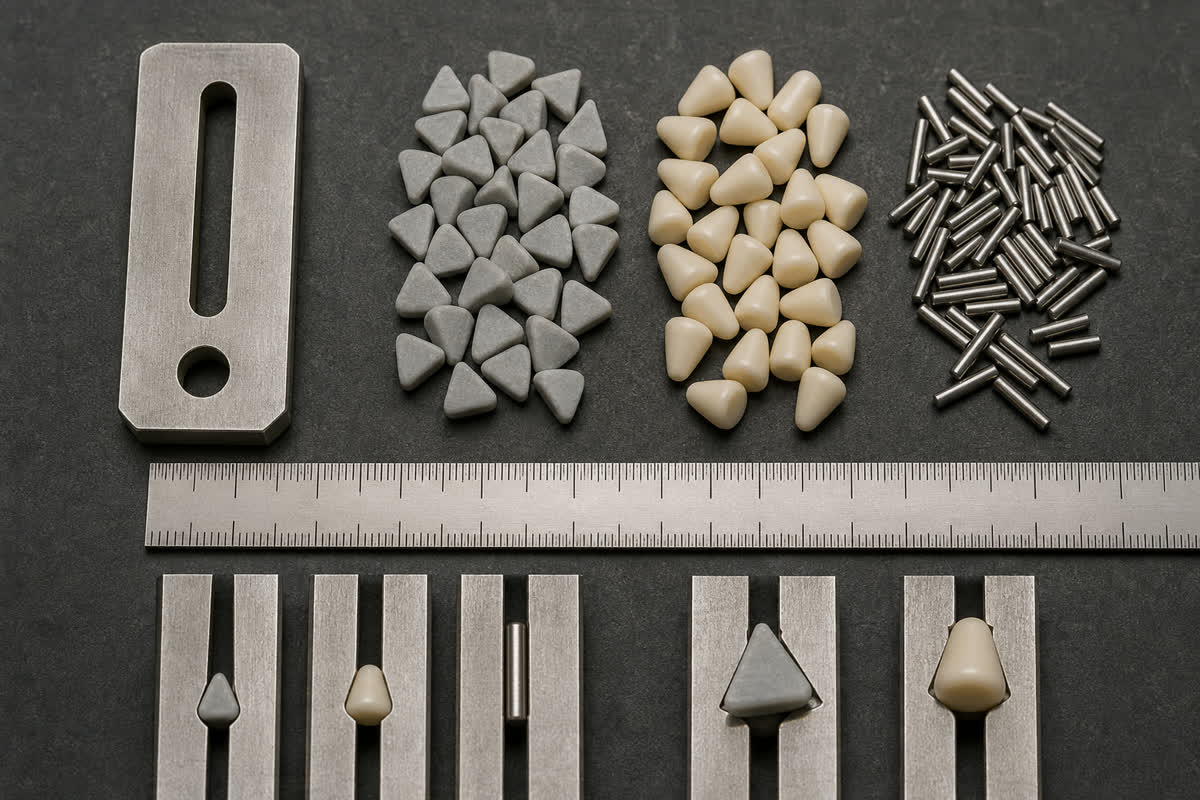
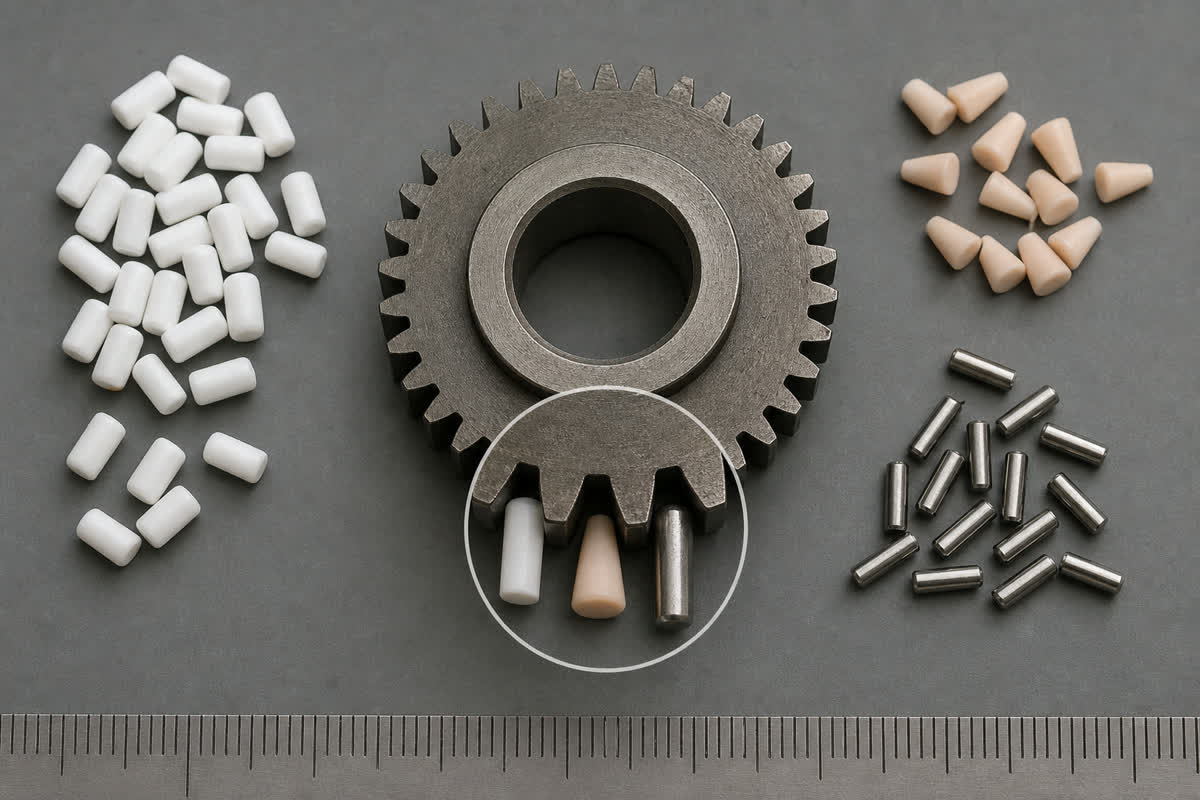
Cylindrical media offers a combination of curved side contact and end contact. Angle-cut ends can present narrower contact lines to edges and shallow features. The practical question is whether the cylinder can circulate freely around the part without aligning across a slot or entering a hole where it cannot be separated.
Triangular media presents corners and flat faces. This can make it useful when a trial needs more defined access near edges or into open recesses, but the same geometry creates orientation-dependent contact. Check whether a triangle can wedge across a feature, mark a protected face or become trapped as it wears.
Tapered media can approach openings with different contact widths along its length. That does not mean it will safely enter every recess. Compare the full profile with the opening, depth and exit path, and inspect for bridging or wedging after each trial step.
Complex profiles provide multiple contact points, but their fit and separation behavior are highly part-dependent. Do not select them simply because they appear more aggressive. Confirm that their arms or lobes cannot catch on cross-holes, slots, threads or thin features, and verify that the worn profile remains separable.
Ceramic formulation, abrasive behavior, density, size, wear state and the machine motion all affect the result. Water and compound conditions also influence transport, cleanliness and residue. Treat the shape comparison as one controlled variable rather than a complete process recipe. The ceramic media category can orient the material discussion, but it does not replace a part-specific trial.
If part-on-part contact is the main risk, media shape is only one control. Review loading, media coverage and motion using the part-on-part damage prevention guide.
Keep the part lot, incoming condition, machine, load, compound condition and inspection method consistent while comparing candidate shapes. Photograph critical features before and after, record media identity and wear state, and inspect for retained media before accepting the surface result. Final media choice should be based on the required edge and surface condition plus reliable separation—not appearance alone.
No. The useful contact pattern and the lodging risk depend on the part geometry, protected surfaces, process motion and media condition.
Not automatically. A piece that can enter may lodge, while a larger piece can bridge across an opening. Evaluate the complete shape, orientation, wear range and separation method.
No. Media formulation, size, wear, machine motion, compound condition and starting surface also matter. Confirm the combination in a controlled trial.
Recheck when wear changes the fit relative to critical holes, slots or recesses, and before the worn profile compromises separation or process consistency.
Send SurfacePolish part drawings or clear photos, material, incoming burr or surface condition, protected features, critical openings, batch quantity and inspection method. We can use those details to define candidate media shapes and a controlled sample-trial checklist without assuming a universal recipe.
Correo electrónico : info@surface-polish.com


 Compatible con red IPv6


 +86-592-2381506